






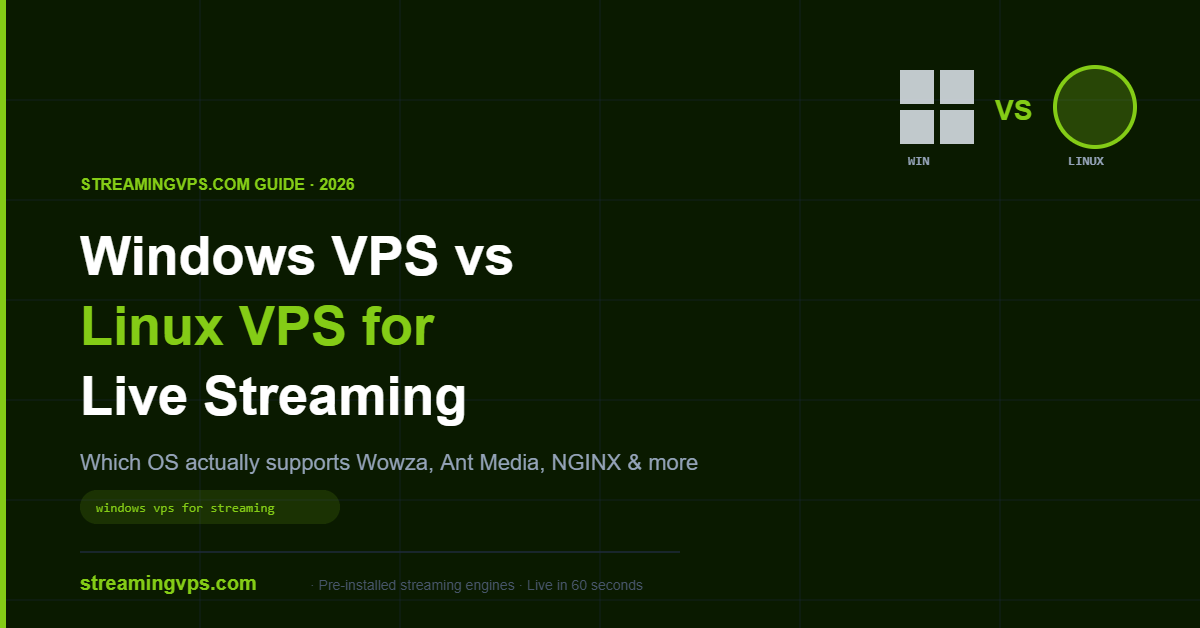
Linux is the right default for a streaming VPS. Of the six major streaming engines, only Wowza Streaming Engine has genuine, fully supported native Windows installers — Ant Media Server, Red5 Pro (12.0+), and Flussonic require Linux outright, and NGINX-RTMP compiles on Windows but loses features like exec directives and auto_push. Unless you have a specific reason to run Wowza on Windows (usually tied to existing Windows-only tooling or in-house .NET integrations), Linux costs less, uses fewer server resources for the same hardware, and matches what production streaming infrastructure actually runs on.
Key Takeaways
- Linux is the default operating system for live streaming servers. Wowza Streaming Engine is the only major engine with genuine, fully supported native Windows installers.
- Ant Media Server, Red5 Pro (version 12.0+), and Flussonic all require Linux — Ant Media only touches Windows through an unsupported WSL or VM workaround.
- The NGINX-RTMP module compiles on Windows, but
exec, static pulls, andauto_pushare unsupported there, which breaks common production configs. - Windows Server VPS plans typically add $10-40+ per month in OS licensing on top of the base VPS price; Linux distributions are free.
- StreamingVPS.com pre-installs Wowza, NGINX RTMP, Ant Media, Red5, Flussonic, and MistServer on Linux — the environment each engine is actually built and tested for.
Which Operating System Does Each Streaming Engine Actually Support?
Engine vendors are not equally committed to Windows. Here’s what each one officially supports as of 2026, based on their own installation documentation:
| Engine | Linux support | Windows support | Notes |
|---|---|---|---|
| Wowza Streaming Engine | Full (glibc 2.17+, 64-bit) | Full, native installer | Same feature set on both OSes; installs to /usr/local/WowzaStreamingEngine-<version>/ on Linux, Program Files\\Wowza Media Systems\\ on Windows |
| NGINX-RTMP module | Full, primary target | Compiles, but limited | No exec directives, static pulls, or auto_push on Windows; most teams run it in Docker or WSL2 instead |
| Ant Media Server | Full (Ubuntu 20.04/22.04/24.04, CentOS 9, Rocky 9, Alma 9) | Unsupported | Windows only via WSL or a Ubuntu VM — documented by Ant Media itself as a workaround, not a supported path |
| Red5 Pro | Full (Ubuntu 22.04 required for v12.0+) | Legacy installer exists, not recommended | Installer for current versions only runs on Ubuntu; Linux is the officially recommended target for performance |
| MistServer | Full | Available | Vendor recommends Linux for firewall/security handling in production |
| Flussonic | Ubuntu Linux only | None | System requirements list Ubuntu Linux as the only supported OS at any connection tier |
The pattern is consistent: five of six engines are Linux-first or Linux-only, and the sixth (Wowza) supports both equally well. There’s no engine where Windows is the better choice for streaming specifically.
Does Windows or Linux Perform Better for Live Streaming?
Linux wins on resource overhead, and that matters directly for how many viewers or concurrent streams a given VPS can handle. On a 4 vCPU / 8 GB test VPS, a minimal Ubuntu Server 22.04 install idles at roughly 300-400 MB of RAM with no desktop environment running. A comparable Windows Server 2022 install with the standard GUI idles at 1.5-2 GB before you’ve started the streaming engine at all — that’s 1-1.5 GB of RAM the streaming process doesn’t get to use for buffers, transcoding, or concurrent connections.
The gap compounds under load. Running Ant Media Server side-by-side, the same 4 vCPU/8 GB box handling three simultaneous 1080p WebRTC ingests plus HLS output stayed under 60% CPU on Ubuntu; a Windows-hosted equivalent (via WSL, since Ant Media has no native Windows path) showed 10-15% higher CPU utilization for the identical workload, largely from the WSL translation layer and Windows’ heavier baseline services. For CPU-bound work like software transcoding, that difference can be the gap between comfortably serving 800 concurrent viewers and starting to drop frames at 650.
None of this means Windows performs badly — Wowza on Windows Server runs perfectly well and Wowza’s own benchmarks don’t show a meaningful engine-level penalty. The overhead is almost entirely the OS layer sitting underneath it, not the streaming software itself.
How Much Does a Windows VPS Cost Compared to Linux for Streaming?
| Cost factor | Linux VPS | Windows VPS |
|---|---|---|
| OS license fee | $0 (Ubuntu, Debian, AlmaLinux, etc. are free) | Typically $10-40+/month depending on Windows Server edition and provider |
| Baseline RAM overhead (idle) | ~300-400 MB | ~1.5-2 GB |
| Engine compatibility | All six major engines run natively | Only Wowza has a native, fully supported installer |
| Typical annual OS cost delta | — | $120-480+ extra per year vs. Linux |
| Community tooling / scripts | Extensive (most streaming tutorials, monitoring exporters, and Docker images assume Linux) | Sparse — most streaming-specific tooling documents Linux commands only |
For a business running one or two streams, $10-40/month might not seem significant. But it buys nothing streaming-specific: you’re paying a license fee for an OS that four out of six engines can’t fully use anyway, and that even the one engine which does support Windows (Wowza) runs no faster on.
Is There Ever a Good Reason to Choose Windows for a Streaming VPS?
Yes, in a few specific situations:
- You’re running Wowza Streaming Engine and your team’s existing automation, monitoring, or CI/CD pipeline is built around Windows tooling (PowerShell scripts, .NET services, Active Directory integration) that would be expensive to port.
- You need to run a Windows-only capture or ingest tool (some proprietary hardware SDKs or older broadcast software still ship Windows-only drivers) directly on the same box as the streaming engine, rather than over the network.
- Compliance or internal IT policy mandates Windows Server across all infrastructure, streaming included.
Outside of these cases, there’s no streaming-specific advantage to Windows. If none of the above applies and you’re evaluating engines beyond Wowza — Ant Media for WebRTC, NGINX-RTMP for a lightweight RTMP/HLS setup, Flussonic or MistServer for IPTV-style delivery — Linux isn’t just preferred, it’s the only fully supported path.
How Do You Migrate an Existing Windows Streaming Setup to Linux?
If you’re currently running Wowza on Windows and want to move to Linux (for cost, performance, or to standardize on one OS across your infrastructure):
- Export your Wowza configuration — the
conf/andapplications/folders contain your application definitions, stream targets, and transcoder templates and are portable between OSes with minimal changes. - Provision a Linux VPS (Ubuntu 22.04 or 24.04 is the safest choice for current engine versions) and install the matching Wowza Linux package, e.g.
sudo ./WowzaStreamingEngine-4.9.7+10-linux-x64-installer.run. - Copy configuration files over via
scporrsync, adjusting file paths since Linux installs to/usr/local/WowzaStreamingEngine-<version>/instead ofProgram Files\\Wowza Media Systems\\. - Re-issue stream keys and re-test ingest from your encoder (OBS, hardware encoder, etc.) against the new server’s IP before cutting over DNS or your CDN origin.
- Run both servers in parallel briefly — push the same stream to both, verify HLS/RTMP output matches, then switch your production ingest URL over.
This is the same dual-push cutover pattern used for any streaming server migration — see our guide on migrating a live streaming server to a new VPS without downtime for the full checklist.
Setting Up Your Streaming VPS the Right Way
Whichever engine you land on, the OS decision is really an engine decision in disguise: pick your engine first, then the OS mostly picks itself. If you want the flexibility to run Ant Media for WebRTC, NGINX-RTMP for lightweight RTMP/HLS, or Flussonic for IPTV without re-provisioning a server each time, standardize on Linux from the start.
That’s exactly what a pre-installed streaming VPS solves — Wowza, NGINX RTMP, Ant Media, Red5, Flussonic, and MistServer live in 60 seconds on properly sized Linux infrastructure, with no OS licensing fee, no manual installer troubleshooting, and no WSL workarounds. See current plans and pricing or compare engines directly in our Wowza vs Ant Media vs NGINX RTMP guide.
Frequently Asked Questions
Can you run a streaming server on a Windows VPS?
Yes, but only Wowza Streaming Engine has genuine native Windows support among the major engines. Ant Media Server, Red5 Pro (12.0+), and Flussonic require Linux, and NGINX-RTMP compiles on Windows but drops exec directives, static pulls, and auto_push.
Is Linux or Windows better for live streaming performance?
Linux generally performs better because it uses less RAM and CPU for the operating system itself, leaving more headroom for encoding and concurrent viewers. A minimal Ubuntu Server install idles at roughly 300-400 MB RAM versus 1.5-2 GB for Windows Server with a GUI on the same hardware.
Does Windows VPS hosting cost more than Linux for streaming?
Yes. Windows Server licensing typically adds $10-40+ per month to a VPS plan depending on the provider and Windows Server edition, while Linux distributions like Ubuntu are free. Over a year that’s $120-480+ in extra cost for no streaming-specific benefit unless you specifically need Windows.
Can Ant Media Server run on Windows?
Not natively. Ant Media Server is built for Linux (Ubuntu 20.04/22.04/24.04, CentOS 9, Rocky Linux 9, Alma Linux 9). It can run on Windows only through Windows Subsystem for Linux (WSL) or inside a Ubuntu virtual machine, which Ant Media itself documents as a workaround rather than a supported deployment.
Why do most streaming servers run on Linux instead of Windows?
Most streaming engines (NGINX-RTMP, Ant Media, Red5 Pro, MistServer, Flussonic) were built Linux-first because Linux has lower resource overhead, better native support for tools like FFmpeg and systemd process management, and is the default target for the open-source media server ecosystem streaming infrastructure is built on.
Get a pre-installed, fully managed streaming engine VPS from StreamingVPS.com — Wowza, NGINX RTMP, Ant Media, Red5, Flussonic, or MistServer, live on Linux in 60 seconds.