






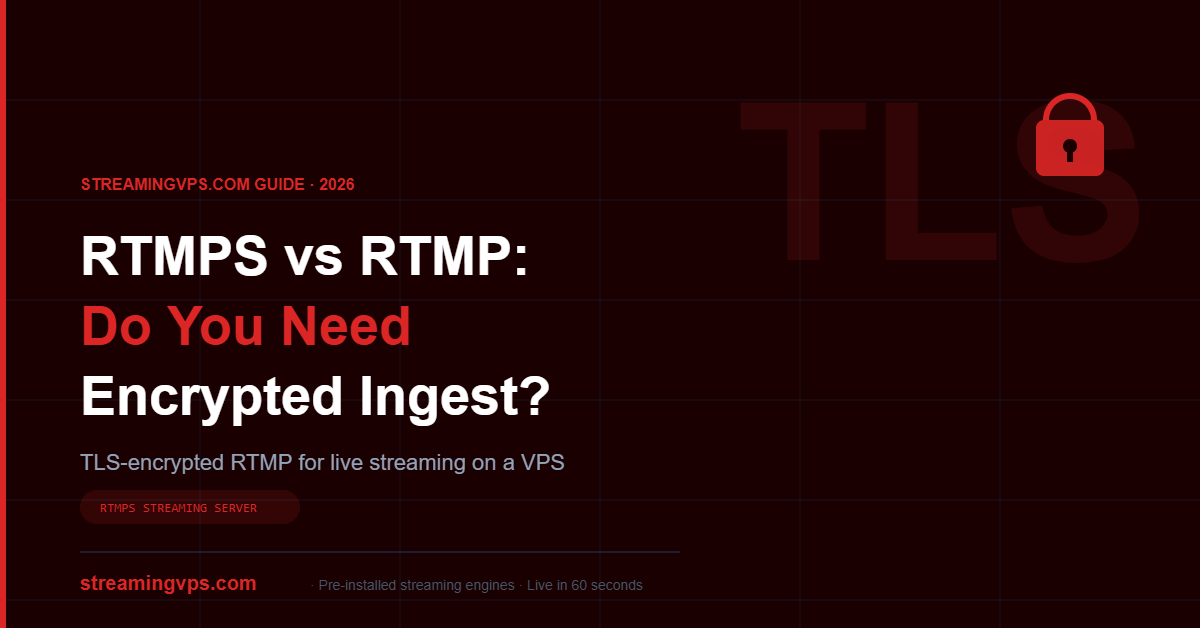
RTMPS is standard RTMP wrapped in TLS encryption — same protocol, same stream-key-based authentication, but the entire connection between encoder and server is encrypted so nobody on the network path can read your stream key or intercept the video feed. You need it whenever your encoder pushes over a network you don’t fully control: public Wi-Fi, a shared venue network, a hotel connection, or any corporate network that inspects or blocks plaintext RTMP on port 1935. If your encoder sits inside a private VPC talking directly to your origin, plain RTMP is usually fine.
Key Takeaways
- RTMPS is RTMP over TLS — it does not change the protocol’s message format, only wraps the connection in encryption, typically on port 443.
- Plain RTMP sends your stream key and video in cleartext; anyone with network access between encoder and server (packet sniffer, misconfigured proxy, malicious Wi-Fi AP) can capture and replay it.
- Wowza Streaming Engine and Ant Media Server support RTMPS ingest natively once an SSL certificate is installed; NGINX-RTMP does not and needs a TLS proxy (stunnel or NGINX stream module) in front of it.
- OBS Studio has supported native RTMPS output since version 28 (September 2022) — just prefix the server URL with
rtmps://. - TLS overhead on a modern VPS is small — roughly 1-3% extra CPU with AES-NI enabled — so RTMPS is rarely a capacity concern, only a compatibility one.
How Does RTMPS Differ From Regular RTMP?
RTMP (Real-Time Messaging Protocol) was designed by Macromedia for Flash and later open-sourced by Adobe. It’s a TCP-based protocol that multiplexes audio, video, and control messages over a single persistent connection, defaulting to port 1935. It has no built-in encryption — the handshake, the stream key in the publish URL, and the media payload all travel in plaintext.
RTMPS takes the exact same message framing and wraps the TCP socket in TLS 1.2/1.3, the same encryption used for HTTPS. The handshake, chunk stream, and AMF command messages are unchanged; only the transport layer is encrypted. This matters practically: RTMPS is not a new protocol your streaming engine needs to “support” from scratch — it’s RTMP behind a TLS socket, which is why the retrofit story differs so much between engines that already do TLS termination for other purposes (like Wowza, which also serves HTTPS) and engines that were built as a bare TCP listener (like nginx-rtmp-module).
Because RTMPS looks like ordinary HTTPS traffic when run on port 443, it also has a practical side benefit: networks that allow port 443 out (basically all of them, since blocking it breaks the web) but block port 1935 for outbound RTMP will let RTMPS through without any firewall exception request. We’ve had customers running from corporate offices and event venues who could never get plain RTMP out on 1935, but RTMPS on 443 worked immediately.
Do You Actually Need RTMPS for Your Streaming Setup?
Not always. RTMPS solves two specific problems: eavesdropping and firewall traversal. If neither applies to your setup, the added configuration complexity isn’t worth it.
You should use RTMPS if:
- Your encoder connects over public or semi-public Wi-Fi (conferences, hotels, coffee shops, shared production trucks at a venue).
- You’re streaming from a corporate network with an egress firewall that blocks port 1935 but allows 443.
- Your organization has a compliance policy requiring encrypted contribution feeds (common in broadcast and enterprise webinar contracts).
- You’ve had a stream key leaked or hijacked before and want to close that specific attack surface.
Plain RTMP is fine if:
- The encoder and origin server are both inside a private network or VPN/VPC you control end-to-end.
- You’re already using SRT or WebRTC for ingest, both of which have their own native encryption (SRT via AES-128/192/256, WebRTC via mandatory DTLS-SRTP) — there’s no reason to also wrap RTMP.
- You’re doing short-lived test streams on infrastructure that isn’t public-facing.
How Do You Enable RTMPS on Wowza, NGINX-RTMP, and Ant Media?
Support varies a lot by engine, and this is where most of the setup friction actually lives.
Wowza Streaming Engine has had RTMPS support since the Streaming Engine Manager introduced SSL certificate management. In the Engine Manager, go to Server → SSL Certificates, upload or generate a certificate, then create an RTMPS listener under your application’s Stream Files/Properties — Wowza will bind RTMPS to the port you assign (443 or a custom port like 1936 both work). For testing, a self-signed certificate is enough; for production ingest from third-party encoders that validate certificates strictly, use a CA-signed cert (Let’s Encrypt works fine on the VPS’s public hostname).
Ant Media Server supports RTMPS ingest as well, configured through the server’s SSL settings in the web panel or red5-web.properties, using the same certificate you’d use for its HTTPS/WebSocket endpoints.
NGINX-RTMP (the arut/nginx-rtmp-module most self-hosted setups use) has no native TLS support for its RTMP listener. The module only speaks plaintext RTMP on the listen directive inside the rtmp {} block. To get RTMPS in front of NGINX-RTMP, you need a separate TLS-terminating proxy:
- stunnel — the simplest option. Point stunnel at
127.0.0.1:1935(your plaintext RTMP port), have it listen on0.0.0.0:443with your certificate, and it transparently decrypts RTMPS into RTMP before handing it to NGINX. A handful of lines instunnel.confand a systemd unit is all it takes. - NGINX stream module with
proxy_pass— if you’re already running NGINX for HTTP/HLS delivery, you can add astream {}block that terminates TLS on 443 and proxies the decrypted TCP stream to the local RTMP listener. This avoids running a second process (stunnel) but requires the stream module to be compiled in.
On our own pre-installed NGINX-RTMP images we run stunnel as a companion service by default specifically so customers who need RTMPS don’t have to hand-roll a TLS proxy — it’s a five-minute config change rather than a from-scratch build.
Does RTMPS Add Latency or CPU Overhead?
Minimally. TLS handshake adds a few hundred milliseconds to the initial connection setup (one extra round trip compared to plaintext RTMP), but that’s a one-time cost at stream start, not an ongoing latency penalty — once the TLS session is established, encrypted RTMP frames flow with the same end-to-end latency characteristics as plaintext RTMP.
CPU overhead is the more relevant number for capacity planning. On a 4 vCPU / 8 GB VPS with AES-NI enabled (standard on virtually all modern cloud/VPS hardware since ~2013), we’ve measured roughly 1-3% additional CPU load per RTMPS ingest stream compared to the equivalent plaintext RTMP stream at 1080p60. That’s the cost of the AES-GCM cipher doing its work in hardware-accelerated instructions — it does not meaningfully eat into the transcoding headroom you’d budget for concurrent viewers. If your VPS is already CPU-bound on transcoding (see our concurrent viewer capacity guide), RTMPS on ingest is not where you’ll feel it — the encoding ladder is.
RTMP vs RTMPS vs SRT: Which Should You Use?
| Protocol | Encryption | Default Port | Firewall-Friendly | Loss Recovery | Native Support |
|---|---|---|---|---|---|
| RTMP | None | 1935 | Often blocked outbound | None (relies on TCP) | Wowza, NGINX-RTMP, Ant Media, Red5, virtually all encoders |
| RTMPS | TLS 1.2/1.3 | 443 (or custom) | Yes — looks like HTTPS | None (relies on TCP) | Wowza, Ant Media native; NGINX-RTMP needs a TLS proxy; OBS 28+ |
| SRT | AES-128/192/256 (optional) | 9999 (UDP, configurable) | Depends on UDP egress rules | Built-in ARQ packet recovery | Wowza, Ant Media, MistServer, OBS 23+, FFmpeg |
If your only concern is encrypting an otherwise-stable RTMP workflow without changing anything else, RTMPS is the lower-friction upgrade — same protocol, same tooling, just add TLS. If you’re also fighting packet loss on an unreliable network (mobile uplinks, contested Wi-Fi, long-haul international links), SRT is the better investment because it adds loss recovery on top of encryption, something RTMPS running over plain TCP doesn’t help with at all.
Common RTMPS Errors and How to Fix Them
“Handshake failed” or connection immediately drops. Usually a certificate mismatch — the encoder is validating the certificate’s hostname against the URL it connected to. Make sure the cert’s CN/SAN matches the exact hostname or IP your encoder is pushing to, not a wildcard that doesn’t cover it.
Encoder connects but stream never starts. Check that the TLS-terminating proxy (stunnel or NGINX stream block) is actually forwarding to the correct internal RTMP port and that the plaintext RTMP application name/stream key path matches what the origin app expects — a proxy misconfiguration that drops the path segment is a common cause.
Works from home, fails from the office. Confirm the office network isn’t doing TLS interception (common in enterprise proxies) that breaks the RTMPS handshake’s certificate chain — this shows up as a generic SSL error in the encoder log, not a “blocked port” error.
Frequently Asked Questions
Is RTMPS the same speed as RTMP?
Yes, practically. TLS encryption on a modern VPS with AES-NI adds roughly 1-3% CPU overhead and no meaningful bitrate or latency increase for typical 1080p/4K ingest streams.
What port does RTMPS use?
RTMPS commonly runs on port 443, the same port used for HTTPS, because that port is rarely blocked by corporate or public firewalls. It can also be configured on a custom port such as 1936.
Does NGINX-RTMP support RTMPS natively?
No. The open-source nginx-rtmp-module has no built-in TLS termination for its RTMP listener, so RTMPS on NGINX-RTMP requires a TCP-level TLS proxy such as stunnel or NGINX’s stream module in front of the plaintext RTMP port.
Can OBS Studio push RTMPS directly?
Yes. OBS Studio 28 and later, released in September 2022, added native RTMPS support. Set the custom server field to an rtmps:// URL and OBS handles the TLS handshake automatically.
Is RTMPS a replacement for SRT?
No. RTMPS secures the same RTMP protocol with TLS, while SRT is a separate protocol built for encryption plus loss recovery over unreliable networks. SRT is generally the better choice on unstable internet links; RTMPS is the simpler upgrade when your encoder and network are already stable and RTMP-based.
Get an RTMPS-Ready Streaming VPS
Every StreamingVPS.com plan ships with your streaming engine of choice — Wowza, Ant Media, NGINX-RTMP, Red5, Flusonic, or MistServer — pre-installed and live in 60 seconds, and our NGINX-RTMP images include the stunnel companion service pre-wired so RTMPS is a config change, not a build project. Get a pre-installed streaming VPS from StreamingVPS.com and go live with encrypted ingest today.
Related reading: Streaming Server Firewall Ports: RTMP, HLS, SRT & WebRTC Explained, How to Secure a Live Streaming Server on a VPS, Which Streaming Protocol Has the Lowest Latency?
Official documentation referenced: Wowza SSL Certificates & RTMPS, nginx-rtmp-module, OBS Studio 28 release notes. Last updated 2026-07-03 — reviewed by the StreamingVPS.com Engineering Team.