


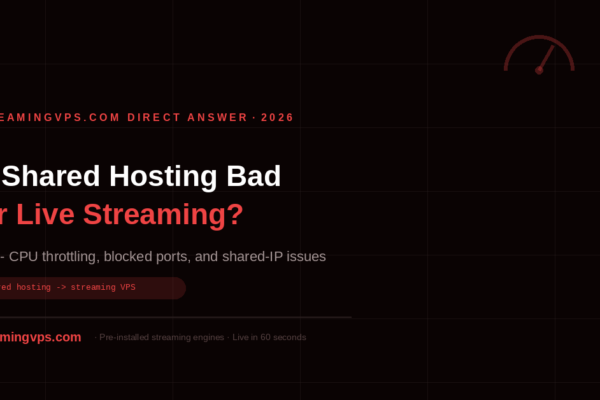
Is Shared Hosting Bad for Live Streaming? (Direct Answer)
Yes, shared hosting is bad for live streaming: CPU throttling, blocked RTMP ports, and shared-IP problems cause buffering and drops. Here’s when it’s fine.
Yes, shared hosting is bad for live streaming: CPU throttling, blocked RTMP ports, and shared-IP problems cause buffering and drops. Here’s when it’s fine.

Live stream chat moderation on a VPS explained: real-time profanity filtering with AI classifiers, spam rate-limiting, and username/IP/token ban enforcement.

Self-hosted streaming vs Mux, Cloudflare Stream & Vimeo compared on cost, control and latency. Get a pre-installed streaming VPS from StreamingVPS.com.

Media over QUIC (MoQ) blends WebRTC-like latency with HLS-scale CDN delivery. See how it works, which engines support it, and how to test it on a VPS.

IPTV channel zapping time is the lag when switching channels. Cut it with GOP tuning and prepush buffering on a Flussonic/Wowza VPS — live in 60 seconds.
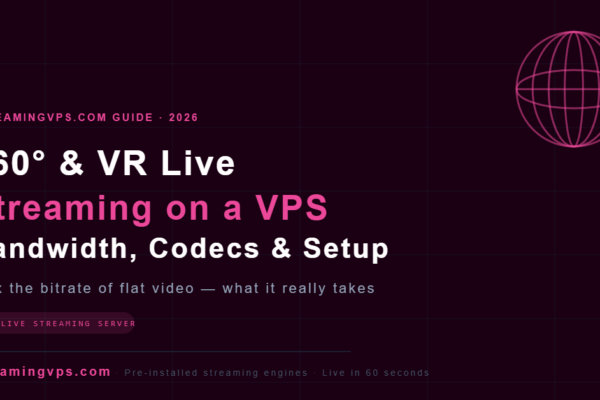
360 degree and VR live streaming needs 4 to 6x normal bitrate plus GPU transcoding. See real VPS specs, codecs, and setup steps from StreamingVPS.com tests.
An RTMP stream key leak lets anyone publish to your ingest. See how keys leak, what to check, and how to rotate keys safely on Wowza, NGINX-RTMP & Flussonic.
The Flussonic HTTP API lets you script stream, DVR & event automation over REST/JSON. See real endpoints, auth, and setup on a streaming VPS.

Flussonic Watcher turns any VPS into a cloud NVR for IP cameras. See sizing numbers, ONVIF setup steps, storage math, and how it compares to DIY FFmpeg.

Load test a streaming VPS by simulating both ingest (RTMP/SRT publishers) and delivery (HLS/WebRTC viewers) at peak concurrency, then watch CPU, bandwidth, and latency as load scales up.