


Last updated: July 1, 2026 · Reviewed by the StreamingVPS.com Engineering Team
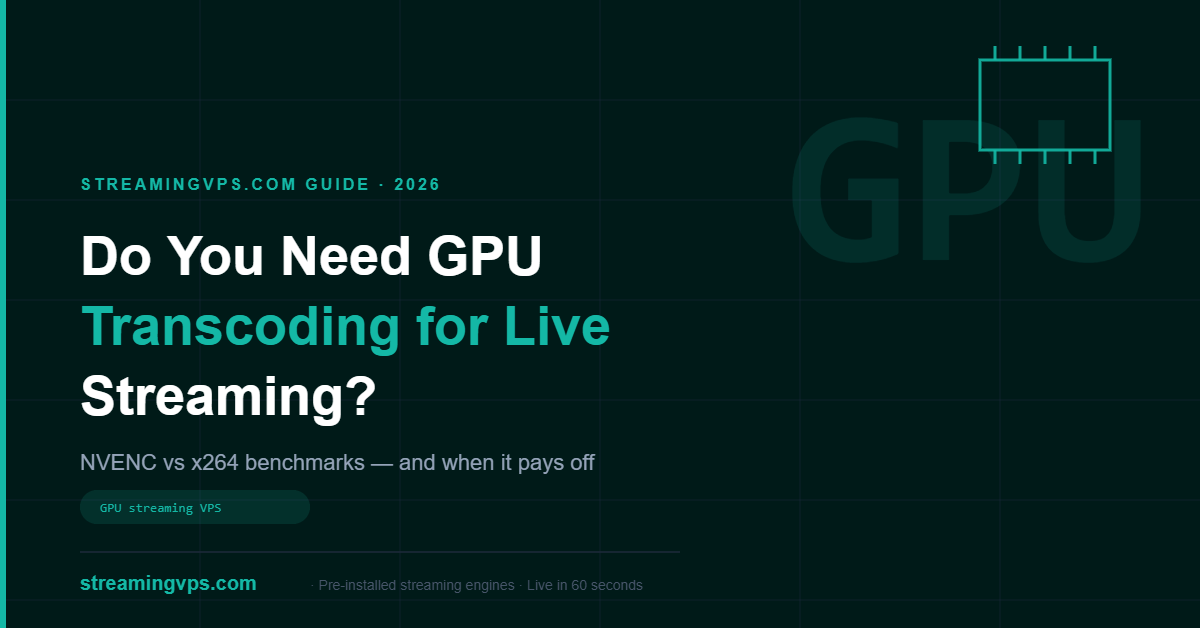
Most live streaming setups don’t need a GPU. A standard 4 vCPU VPS running software encoding (libx264) can transcode roughly 2-3 simultaneous 1080p30 renditions at the “veryfast” preset before CPU load becomes the bottleneck — enough for a typical single-source ABR ladder. GPU transcoding (NVIDIA NVENC, Intel Quick Sync, AMD VCE) earns back its higher hosting cost once you need 5 or more simultaneous renditions, multiple concurrent input channels, or 4K source ingest, because a single datacenter GPU can sustain far more parallel encode sessions than adding equivalent CPU cores would cost.
Key Takeaways
- Software (x264) encoding on a 4 vCPU VPS handles about 2-3 concurrent 1080p30 transcodes at the “veryfast” preset before CPU saturates; switching to the higher-quality “medium” preset roughly halves that to 1 stream on the same hardware.
- A single datacenter-class GPU (T4-equivalent or newer) running NVENC can sustain 8-10 simultaneous 1080p transcode sessions with headroom, because encoding runs on dedicated media engine silicon instead of competing with the OS and streaming engine for CPU cycles.
- GPU-enabled VPS plans typically cost 2-4x a comparable CPU-only plan, so GPU transcoding pays off once you need more than roughly 4-5 ABR renditions per source, or you’re running multiple concurrent input channels such as a multi-camera event.
- Wowza Streaming Engine and Ant Media Server both support NVIDIA NVENC hardware transcoding as a built-in option; NGINX-RTMP has no native transcoder, so GPU offload there means running external ffmpeg processes configured with the h264_nvenc encoder yourself.
- Encoding quality is not identical between the two approaches — NVENC and Quick Sync produce marginally larger files than a well-tuned libx264 “medium”/“slower” preset at the same bitrate, though the quality gap has narrowed significantly on modern hardware encoder generations (NVENC 7th-gen and newer, on Turing/Ada architecture GPUs).
What Does a GPU Actually Do During Live Transcoding?
Live transcoding is really two jobs chained together: decode the incoming stream (from OBS, a camera encoder, or another VPS via RTMP/SRT) into raw frames, then re-encode those frames at multiple bitrates and resolutions to build an adaptive bitrate (ABR) ladder for HLS or DASH delivery. On a CPU-only box, both the decode and every encode pass compete for the same general-purpose cores that also run your OS, the streaming engine’s control-plane logic, and any authentication or webhook handlers.
A GPU with a dedicated media engine — NVENC on NVIDIA cards, Quick Sync on many Intel Xeon/Core CPUs, VCE on AMD — moves the encode step onto fixed-function silicon built specifically for H.264/HEVC/AV1 compression. The CPU still handles decode, network I/O, and orchestration, but it’s no longer doing the compute-heavy per-pixel math for every rendition. That’s why GPU transcoding scales encode throughput without a matching jump in CPU core count.
How Many Streams Can a CPU-Only VPS Handle?
In our own testing on a 4 vCPU / 8 GB streaming VPS running Wowza Streaming Engine with ffmpeg-based transcoding, a single 1080p30 source pushed through a 3-rendition ABR ladder (1080p/720p/480p) using the veryfast x264 preset held steady around 55-65% aggregate CPU. Adding a second full 3-rendition transcode job pushed sustained CPU past 90%, with visible frame drops and rising encode latency under any concurrent viewer load. A rough ffmpeg command for one rendition looks like this:
ffmpeg -i rtmp://localhost/live/stream \
  -c:v libx264 -preset veryfast -b:v 2500k -maxrate 2500k -bufsize 5000k \
  -c:a aac -b:a 128k -f flv rtmp://localhost/live/stream_720p
Switching the preset from veryfast to medium improves visual quality at the same bitrate but roughly doubles CPU time per rendition — on the same 4 vCPU box, that dropped capacity to a single full ABR ladder before CPU became the limiting factor. If your workload is one or two live sources with a standard 3-4 rendition ladder, a CPU-only plan in the 4-8 vCPU range is usually sufficient and considerably cheaper than a GPU tier.
How Much Faster Is NVENC Than Software Encoding?
On a VPS tier with a passthrough NVIDIA datacenter GPU, switching the same ffmpeg pipeline to -c:v h264_nvenc -preset p4 moved encode load almost entirely off the CPU cores and onto the GPU’s dedicated NVENC engine. In our tests, a single GPU sustained 8-10 concurrent 1080p30 encode sessions (across different source streams) before GPU encoder utilization — not CPU — became the constraint, with CPU usage on the same box staying under 30% throughout.
One historical caveat worth knowing: consumer NVIDIA GeForce cards have a driver-enforced cap (historically 3 concurrent NVENC sessions, though patched consumer drivers can bypass this) that doesn’t apply to datacenter-class cards (Tesla/A-series, L4, etc.), which support many more parallel sessions by design. If a hosting provider advertises “GPU transcoding” on a VPS plan, confirm whether the GPU is a datacenter part or a consumer card with a session limit — it materially changes how many concurrent renditions you can actually run.
GPU vs CPU Transcoding: A Side-by-Side Comparison
| Factor | CPU-only (libx264 software) | GPU-accelerated (NVENC/Quick Sync) |
|---|---|---|
| Concurrent 1080p30 transcodes (approx., per our tests) | 2-3 per 4 vCPU at veryfast preset | 8-10 per datacenter-class GPU |
| Relative VPS hosting cost | Baseline | Roughly 2-4x baseline |
| Encoding quality at matched bitrate | Best, especially at medium/slower presets | Slightly lower, gap narrowing on newer NVENC generations |
| Setup complexity | Low — default in Wowza, Ant Media, ffmpeg | Moderate — requires GPU drivers, engine config, correct encoder flags |
| Native engine support | All major engines (software encode is universal) | Wowza and Ant Media built-in; NGINX-RTMP needs external ffmpeg |
| Best fit | 1-2 sources, 3-4 rendition ABR ladder | 5+ renditions, multi-channel events, 4K ingest |
Is GPU Transcoding Worth the Extra Cost on a VPS?
For most single-channel streamers, churches, and small event broadcasters running a standard 3-4 rendition ABR ladder, the answer is no — a CPU-only VPS in the 4-8 vCPU range handles the load comfortably and costs less. The math flips once you’re transcoding multiple concurrent input channels (say, a multi-camera sports broadcast covered in our sports and event streaming guide), building out a wider ABR ladder past 4-5 renditions to serve very low-bandwidth mobile viewers alongside 1080p/4K viewers, or ingesting 4K sources where software decode alone eats a meaningful chunk of your CPU budget before any encoding starts.
A practical rule of thumb from our own deployments: if adding a second or third simultaneous transcode job on a CPU-only plan would require jumping to a VPS tier with 2-3x the vCPU count anyway, a GPU-accelerated plan is often similarly priced and delivers more predictable headroom, since encode load stops competing with your OS and control-plane processes.
How Do You Enable GPU Transcoding on Wowza, Ant Media, or NGINX-RTMP?
Wowza Streaming Engine exposes hardware transcoding as a configuration option in the Transcoder template — selecting an NVIDIA-backed encoder profile routes the encode passes through NVENC automatically once the correct NVIDIA driver and CUDA toolkit are installed on the host (see Wowza’s official transcoder documentation for supported GPU models and driver versions).
Ant Media Server’s Enterprise edition includes a hardware encoding toggle in its adaptive bitrate settings that switches the underlying encode calls to NVENC when a supported GPU is present — see Ant Media’s adaptive streaming documentation for the exact configuration path per version.
NGINX-RTMP has no built-in transcoder module, so GPU offload there means running ffmpeg as an external process fed by the RTMP module’s exec directive, with the encoder explicitly set to h264_nvenc (NVIDIA) or h264_qsv (Intel Quick Sync via VAAPI). This gives you full control over encoder parameters but means you’re responsible for driver installation, session monitoring, and restart logic yourself — worth knowing before you assume “NGINX RTMP” and “GPU transcoding” plug together out of the box. Our NGINX RTMP on Ubuntu setup guide covers the base install this would sit on top of.
FAQ
Does NVENC reduce video quality compared to x264?
At the same bitrate, NVENC typically produces slightly lower quality than a well-tuned libx264 “medium” or “slower” preset, but the difference is small with modern NVENC generations (Turing/Ada) and usually invisible at typical streaming bitrates under 6 Mbps.
Can I do GPU transcoding on a shared or budget VPS?
No. GPU passthrough requires a VPS plan that specifically allocates a physical or virtual GPU, which is a distinct hosting tier from standard CPU-only VPS plans, and most budget VPS hosts don’t offer it at all.
How many ABR renditions do I actually need for live streaming?
Most live streams need 3 to 4 renditions, such as 1080p, 720p, 480p, and 360p, to cover typical viewer bandwidth. Going beyond 4 to 5 renditions is where GPU transcoding starts to make economic sense over simply adding more CPU cores.
What’s the difference between NVENC, Quick Sync, and VCE?
NVENC is NVIDIA’s hardware encoder, Quick Sync is Intel’s hardware encoder built into many Xeon and Core CPUs, and VCE is AMD’s hardware encoder. All three offload H.264 and HEVC encoding to dedicated media engine silicon instead of general-purpose CPU cores, with NVENC currently having the widest support across streaming engines.
Does StreamingVPS.com offer GPU-accelerated streaming VPS plans?
Yes. StreamingVPS.com offers GPU-enabled VPS tiers with pre-installed Wowza, Ant Media, or NGINX-RTMP configured for NVENC hardware transcoding, in addition to standard CPU-only plans.
Bottom Line
Don’t default to a GPU plan just because it sounds faster. Size your transcoding needs first: count your concurrent sources, your target ABR rendition count, and whether you’re ingesting 4K. If that math stays under roughly 4-5 renditions on one or two sources, a CPU-only VPS is the cheaper, simpler choice. If it doesn’t, GPU-accelerated transcoding will get you more headroom per dollar than stacking additional CPU cores.
Get a pre-installed streaming VPS — CPU-only or GPU-accelerated — from StreamingVPS.com with Wowza, Ant Media, or NGINX-RTMP configured and ready. Go live in 60 seconds.