




IPTV Multicast vs Unicast: Which Delivery Method Does Your VPS Actually Need?
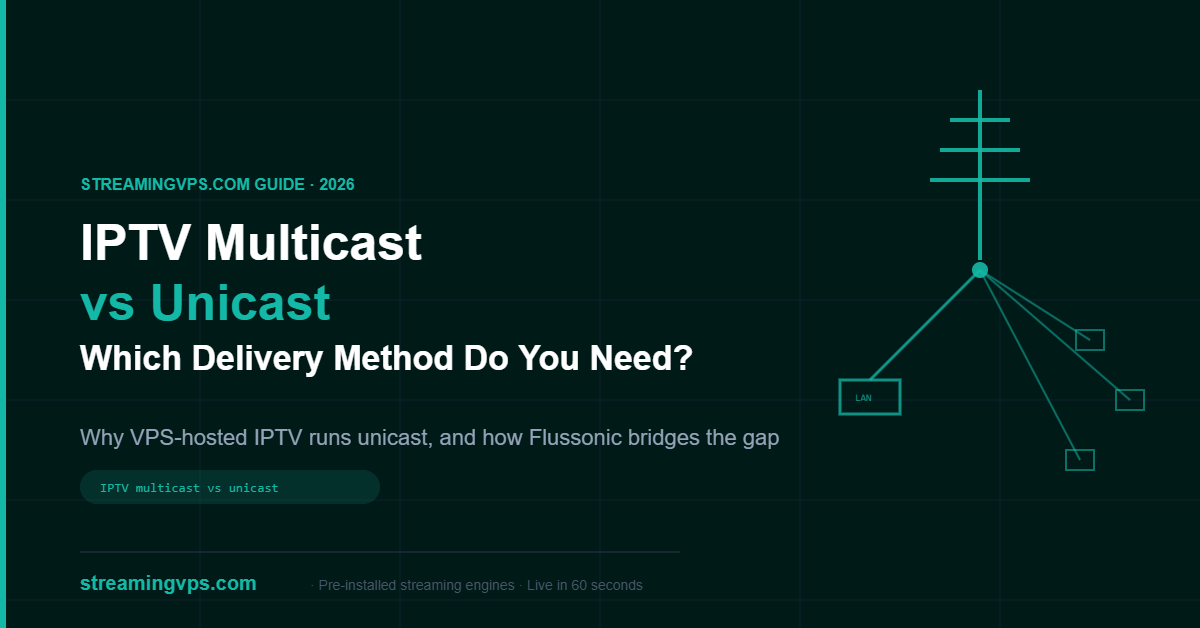
IPTV multicast sends a single copy of a stream across a network, replicated only at the routers/switches that need it, and it only works inside private, IGMP-managed networks — telco last-mile networks, hotel and hospital in-house TV, campus LANs. Unicast delivery (HTTP-based HLS/DASH, or WebRTC/LL-HLS for sub-second latency) opens one connection per viewer, and it’s what nearly every VPS-hosted IPTV or OTT service actually runs, because the public internet does not route native IP multicast between autonomous networks. If you’re deploying on a VPS, you are running unicast by default — multicast only shows up as an ingest source you convert, not as your public output method.
Key Takeaways
- IP multicast does not traverse the public internet. ISPs and internet backbones generally don’t route inter-network multicast traffic, so a VPS reachable from anywhere on the internet cannot serve viewers over native multicast — full stop.
- Multicast is the right tool inside closed, IGMP-capable networks where one operator controls every switch and router hop: telco DSL/fiber last-mile IPTV, hotel/hospital in-house channels, campus or enterprise LANs.
- Unicast (HLS, DASH, WebRTC) is what scales on public VPS infrastructure. It trades shared bandwidth for per-viewer bandwidth, which is exactly why CDN and adaptive bitrate (ABR) ladders matter more as viewer counts climb.
- Flussonic Media Server can ingest a multicast UDP/MPEG-TS feed on one network interface (e.g., a telco LAN link) and re-publish it as unicast HLS, DASH, or RTMP on another — the standard bridge pattern for getting a private multicast feed onto the internet.
- Wowza Streaming Engine can both receive and output UDP/RTP multicast, but that capability only helps if your viewers sit inside the same multicast-enabled network as the server — it is not a way to multicast to internet viewers.
What Is the Difference Between Multicast and Unicast Streaming?
Unicast is a one-to-one connection: every viewer’s player opens its own TCP/HTTP connection to the server, and the server sends that viewer their own copy of the stream. If 500 people watch, the server (or CDN edge) pushes out 500 separate copies of the data. Multicast is one-to-many at the network layer: the source sends a single stream to a multicast group address (in the 224.0.0.0–239.255.255.255 range for IPv4), and routers/switches along the path replicate the packets only at the points where the tree branches — so a single physical link might carry just one copy of the stream even if 500 devices downstream are watching it.
Multicast group membership is managed by IGMP (Internet Group Management Protocol) on IPv4 networks — client set-top boxes send IGMP join/leave messages, and IGMP snooping-aware switches use that signaling to decide which physical ports actually need a copy of the multicast traffic. This is why multicast for live TV works so well on telco and cable networks: the operator owns the routers, configures IGMP snooping on every switch, and can guarantee that only the exact bandwidth needed reaches each neighborhood or building, regardless of how many boxes are tuned to the same channel.
None of that infrastructure exists on the public internet by default. Multicast routing (PIM-SM, PIM-DM, or MSDP for inter-domain multicast) requires every hop between source and receiver to support it, and ISPs generally don’t peer multicast traffic with each other — there’s no commercial or operational incentive to, and the security/abuse surface of open inter-domain multicast is a real concern. So even though the protocol exists and works well inside a single managed network, it effectively stops at the edge of that network.
Why Can’t You Multicast IPTV Over the Public Internet?
Because almost no ISP or cloud provider routes multicast traffic between networks, and because cloud VPS platforms specifically don’t support multicast on their virtual networking layer. When you provision a VPS from a public cloud or VPS host, your server sits on a virtualized network (VLAN/overlay) built for unicast IP forwarding between tenants — most cloud and independent VPS providers explicitly document that native multicast/broadcast isn’t supported between instances, and public internet transit definitely doesn’t carry it either.
Practically, this means: if you deploy Wowza, Flussonic, Ant Media, or NGINX-RTMP on a StreamingVPS instance and configure it to output UDP multicast, home viewers on residential ISPs simply will not receive anything, regardless of how correctly you’ve configured the encoder or the multicast TTL. The stream never leaves your VPS’s local network segment in any form the public internet can carry. This is the single most common IPTV multicast misconception we see — teams assume “multicast” is a general streaming-efficiency feature they can just turn on, when it’s actually a topology requirement that has to be true end-to-end.
How Does Flussonic Convert Multicast to Unicast for VPS Delivery?
This is the real-world bridge pattern, and it’s the reason Flussonic shows up so often in IPTV deployments: Flussonic Media Server can ingest a UDP multicast MPEG-TS feed on one network interface — for example, a dedicated link or VPN tunnel back into a telco’s or content owner’s private multicast network — and simultaneously re-publish that same content as unicast HLS, DASH, or RTMP for delivery to internet viewers on a completely different interface or public IP.
A minimal multicast-input config in flussonic.conf looks like this:
stream iptv_channel_1 {
  input udp://239.1.1.1:1234;
  hls;
  dash;
}
Here, 239.1.1.1:1234 is the multicast group address and port the feed arrives on (Flussonic sends the IGMP join automatically), and the hls/dash directives tell Flussonic to simultaneously transcode/repackage that ingest into unicast ABR outputs that any standard HLS or DASH player can request over ordinary HTTPS. On a server with two network interfaces — one facing the private multicast-capable network, one facing the public internet — you point the multicast listener at the LAN-facing NIC and serve HLS/DASH from the WAN-facing one. Flussonic’s own documentation on multicast receiving covers the IGMP and multi-homing details in more depth if you’re planning this topology (see the official Flussonic multicast manual).
On a 4 vCPU / 8 GB StreamingVPS Flussonic instance, we’ve routinely run 6–8 simultaneous SD/HD multicast-to-unicast channel conversions (each producing a 3-rung ABR ladder) before CPU became the constraint — transcoding cost dominates over the multicast ingest itself, which is nearly free in CPU terms since it’s just packet reception, not decode/encode.
Does Wowza Streaming Engine Support Multicast?
Yes — Wowza Streaming Engine supports both receiving and sending RTP and MPEG-TS streams over UDP multicast, and it lets you specify which network interface handles multicast traffic and tune multicast TTL values, per Wowza’s own documentation. This is genuinely useful if your deployment scenario is “one Wowza server, many viewers, all on the same controlled network” — a corporate campus, a hotel’s internal IPTV backbone, a hospital patient-TV system, or a broadcast facility’s internal monitoring feeds.
What it doesn’t do is get you multicast delivery to viewers scattered across the public internet. If your actual audience is “anyone with an internet connection,” Wowza’s multicast output is the wrong tool regardless of how it’s configured — you want Wowza’s standard unicast HLS/DASH/CMAF packaging (or Wowza Streaming Cloud’s managed CDN distribution, which we cover in our Wowza Cloud vs. Streaming Engine comparison) pointed at a CDN or directly at your VPS’s public IP.
Multicast vs Unicast: Delivery Comparison
| Multicast (UDP/RTP) | Unicast (HLS/DASH/WebRTC) | |
|---|---|---|
| Network requirement | IGMP-capable routers/switches, single managed network | Standard IP routing — works over the open internet |
| Bandwidth scaling | Fixed regardless of viewer count (within the managed network) | Scales roughly linearly per concurrent viewer |
| Works on a public VPS? | No — internet transit doesn’t carry it | Yes — this is the default for VPS-hosted streaming |
| Typical use case | Telco last-mile IPTV, hotel/hospital in-house TV, campus LAN | OTT apps, public websites, mobile viewers, CDN delivery |
| Adaptive bitrate support | No — single fixed bitrate per multicast group | Yes — ABR ladders adjust per viewer’s connection |
| Engines with native support | Wowza Streaming Engine, Flussonic | Wowza, Flussonic, Ant Media, NGINX-RTMP, Red5, MistServer |
| Latency | Very low (no HTTP segment buffering) | Segment-based (HLS: 2–6s typical; WebRTC/LL-HLS: sub-second to ~2s) |
Which Should You Use for Your IPTV or Streaming Project?
If every one of your viewers sits behind infrastructure you or a partner telco controls end-to-end — set-top boxes on a managed DSL/fiber network, an in-house hotel or hospital TV system, a campus network with IGMP snooping switches — multicast is the more bandwidth-efficient choice, and it’s worth asking your network/telco partner whether multicast delivery is available on their last mile. If any part of your audience is “the general public on the open internet,” you need unicast ABR delivery, full stop — that’s what a VPS running Wowza, Flussonic, Ant Media, or NGINX-RTMP will serve by default, and it’s what our IPTV VPS hosting guide and IPTV middleware guide both assume as the delivery model.
Many real IPTV operators actually need both: a multicast feed arrives from a satellite downlink or telco distribution network, and it needs to reach OTT/mobile viewers on the open internet too. That’s exactly the multicast-to-unicast bridge pattern Flussonic specializes in — see our Flussonic setup and use cases guide for the full install and sizing walkthrough.
FAQ
Can I stream multicast IPTV directly from a VPS to home viewers over the internet?
No. Public internet transit and cloud VPS virtual networking do not route native IP multicast between networks, so a multicast stream configured on a VPS never reaches viewers outside that VPS’s own local network segment — you need unicast HLS/DASH/WebRTC delivery instead, or a multicast-to-unicast conversion step like Flussonic’s.
Does multicast use less bandwidth than unicast?
Yes, but only within the managed network where multicast routing is configured — a single multicast stream can serve unlimited viewers on that network for the same bandwidth as one unicast stream. Once you cross into unicast delivery (which is what a public VPS serves), bandwidth scales per viewer regardless of the original source.
What is IGMP and why does it matter for IPTV multicast?
IGMP (Internet Group Management Protocol) is how devices join and leave multicast groups on an IPv4 network, and IGMP snooping on switches uses that signaling to send multicast traffic only to the ports that actually have a subscribed device — without it, multicast traffic would flood every port like a broadcast, defeating its bandwidth advantage.
Can two VPS instances on the same cloud provider communicate over multicast?
Generally no. Most cloud and VPS providers build their virtual networking layer for unicast IP forwarding between tenants and explicitly don’t support native multicast or broadcast traffic between instances, even on a private VLAN — you’d need a unicast-based overlay (like a VPN mesh) to approximate it.
Does Wowza or Flussonic convert unicast back into multicast?
Both can send multicast output alongside unicast on the same source stream — Wowza and Flussonic each support sending live streams as UDP/RTP multicast in addition to unicast HLS/DASH — but that multicast output is only reachable by devices on the same multicast-enabled network as the server, not by internet viewers generally.
Get a Pre-Installed Streaming VPS
Whether you need Flussonic for multicast-to-unicast IPTV conversion, Wowza for a managed in-house multicast deployment, or a straightforward unicast HLS/OTT setup, StreamingVPS.com ships all six major streaming engines pre-installed and fully managed. Go live in 60 seconds — see our streaming engine plans and pricing or the Wowza Streaming VPS product page to get started.
Last updated: July 6, 2026. Reviewed by the StreamingVPS.com Engineering Team.