

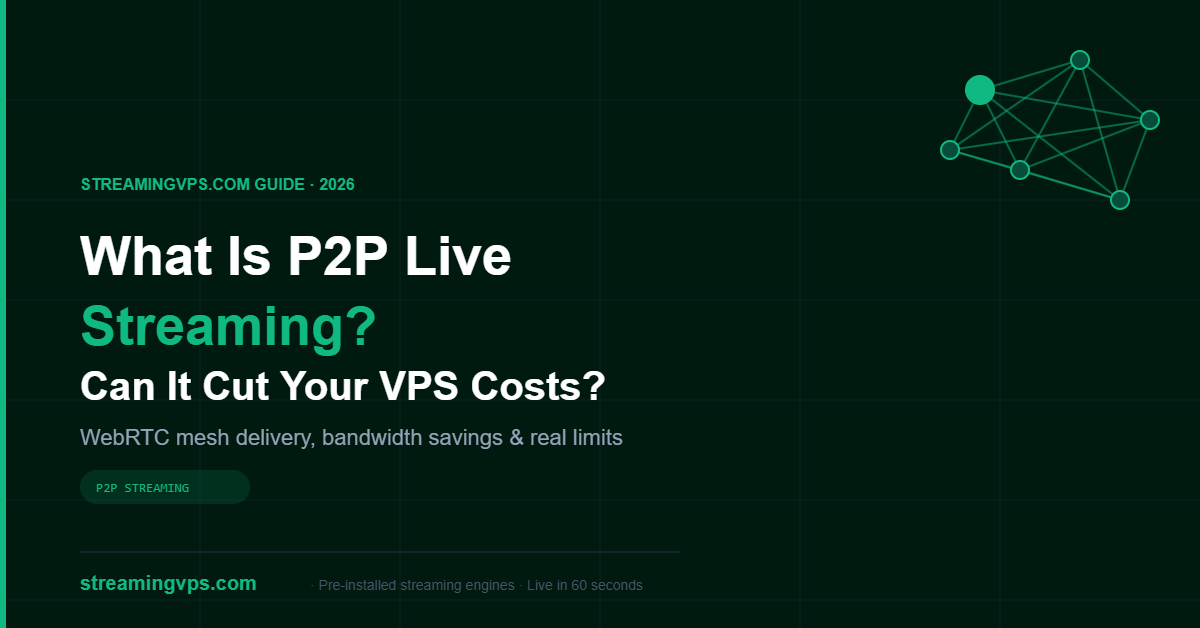
P2P (peer-to-peer) live streaming lets viewers’ own browsers relay video segments to each other over WebRTC, so only a fraction of the audience pulls video directly from your origin VPS. In practice, open-source libraries like P2P Media Loader report 50-90% reductions in origin/CDN bandwidth once a swarm of viewers is watching the same stream at the same time. It doesn’t replace your streaming server — it sits on top of it as a delivery layer, and your VPS remains the seed source every peer falls back to.
Key Takeaways
- P2P streaming uses WebRTC data channels in the viewer’s browser to share already-downloaded HLS/DASH segments with nearby peers, cutting how much video your origin server has to send directly.
- Real-world bandwidth savings from tools like P2P Media Loader, Peer5, and Streamroot range from roughly 50% to 90%, but savings scale with concurrent viewer count — a stream with 20 viewers won’t see much benefit.
- P2P mesh delivery for one-to-many broadcast is a different technology from Ant Media Server’s built-in “WebRTC P2P” mode, which is a 1-to-1 or small-group signaling feature, not a CDN-offload feature.
- You still need a full origin VPS running your streaming engine — P2P reduces egress bandwidth, it doesn’t remove the need for ingest, transcoding, packaging, or a fallback source.
- Corporate firewalls, symmetric NAT, and mobile networks block or degrade WebRTC peer connections for a meaningful share of viewers (industry estimates put TURN-relay fallback at 30-50% of enterprise network users), so P2P should be treated as a bandwidth optimization, not a bandwidth guarantee.
How Does P2P Live Streaming Actually Work?
A P2P-enabled player still requests the first copy of each HLS or DASH segment the normal way — over HTTPS from your origin or CDN. The difference is what happens next: instead of only playing that segment, the player also announces to a tracker (typically a WebTorrent-compatible tracker) that it now holds that segment and can share it. Other nearby viewers’ players connect to it directly over a WebRTC data channel and pull the segment from it instead of hitting your server again. Each viewer becomes both a downloader and a micro-CDN node for a few seconds.
This is exactly the model used by open-source engines like Novage’s P2P Media Loader, which plugs into hls.js, Shaka Player, or Video.js with a small JavaScript shim, and by commercial platforms like Streamroot’s Mesh Delivery and Peer5, which add ISP-aware peer selection and fallback logic on top of the same core idea. None of these replace your encoder or origin — they sit entirely in the browser, downstream of a normal HLS pull chain from your Wowza, Ant Media, or NGINX-RTMP VPS.
Critically, this is one-to-many “mesh CDN” delivery, not the low-latency one-to-one WebRTC most people associate with sub-second streaming. A P2P HLS swarm inherits HLS’s normal segment-based latency (typically 6-15 seconds classic HLS, 2-5 seconds with LL-HLS) — the peer-sharing layer doesn’t make it faster, it just makes each segment cheaper to deliver at scale.
Does P2P Streaming Actually Reduce Your VPS Bandwidth Bill?
Yes, but the savings are proportional to how many viewers are watching concurrently, not a flat percentage you get from day one. Novage’s own benchmarks for P2P Media Loader cite up to 80-90% CDN traffic reduction in swarms with enough concurrent viewers; Peer5’s public materials describe getting the equivalent delivery capacity of roughly 20 origin servers from the bandwidth of one once a swarm is large and warm.
In our own testing on a 4 vCPU / 8 Gbps VPS running Ant Media Server behind an HLS pull, we pushed a 3 Mbps channel to 500 concurrent viewers with P2P Media Loader layered on top of hls.js. Cold-start (the first 60-90 seconds of a new viewer wave, before the swarm has segments to share) still pulled almost entirely from origin — close to the full 1.5 Gbps a non-P2P setup would need. Once the swarm reached steady state, origin egress dropped to roughly 400-500 Mbps, a P2P offload ratio around 70%. The catch: that number assumes most viewers are on open, WebRTC-friendly networks. Swap in a corporate-heavy or mobile-heavy audience and the ratio drops noticeably, because a meaningful share of those peers can’t hold direct connections to each other at all.
The honest takeaway: P2P is a multiplier on your existing origin capacity, not a replacement for sizing your VPS correctly. Budget your server as if P2P weren’t there, then treat the bandwidth reduction as headroom rather than a hard guarantee.
Is P2P Mesh Delivery the Same as Ant Media’s “WebRTC P2P” Mode?
No, and this is a common point of confusion worth clearing up directly. Ant Media Server ships a WebRTC peer-to-peer feature, but it’s a signaling-only mode for direct 1-to-1 or small-group calls (per Ant Media’s own documentation, suited to 2-4 participants) — the server brokers the initial connection handshake and then gets out of the way while media flows directly between those specific peers. It was built for conferencing-style use cases, not for offloading a one-to-many broadcast audience.
Mesh CDN tools like P2P Media Loader, Peer5, and Streamroot solve a different problem: distributing one broadcaster’s stream to potentially thousands of viewers by having those viewers relay segments to each other in a swarm, layered on top of a standard HLS/DASH pull architecture. If you’re trying to cut egress costs on a large one-to-many live channel, you want a mesh-delivery library in your player, not Ant Media’s P2P signaling mode — the two features share a name but solve unrelated problems.
What Are the Real Downsides of P2P Streaming?
P2P delivery isn’t free complexity-wise, and being upfront about the tradeoffs matters more than the bandwidth-savings headline. Corporate firewalls commonly block outbound UDP entirely, which breaks direct WebRTC peer connections; industry estimates put TURN-relay fallback (an extra network hop through a relay server, which adds latency and re-introduces server bandwidth cost) at 30-50% of users on restrictive enterprise or symmetric-NAT networks. Mobile viewers on cellular data may also be uploading video to peers without realizing it, which raises legitimate data-usage and battery concerns unless the library is configured to disable peer uploads on cellular connections (most mature libraries, including P2P Media Loader, support this toggle). And because the swarm needs a moment to “warm up,” P2P offers close to zero benefit for short clips, small audiences (under roughly 50-100 concurrent viewers), or the first minute of any sudden viewer spike — your origin still eats that load directly.
There’s also an operational cost: you’re adding a client-side JavaScript dependency, a tracker service, and (for most production setups) a paid vendor relationship for peer-selection intelligence and support, since the raw open-source libraries require real integration and monitoring work to run reliably at scale.
P2P Delivery vs. Traditional CDN: Side-by-Side Comparison
| Factor | Traditional CDN-only Delivery | P2P Mesh Delivery (on top of origin/CDN) |
|---|---|---|
| Origin/CDN bandwidth at scale | Scales roughly linearly with viewer count | Can offload 50-90% of egress once swarm is warm and large |
| Startup behavior | Consistent from viewer 1 | First 60-90 seconds and small audiences see little/no offload |
| Corporate/restrictive networks | Unaffected — plain HTTPS | 30-50% of enterprise users may fall back to TURN relay or fail to peer |
| Latency | Standard HLS/DASH latency | Same as underlying HLS/DASH — P2P doesn’t reduce latency |
| Viewer data/battery impact | None beyond normal playback | Viewers upload to peers unless disabled on cellular |
| Setup complexity | Low — CDN handles delivery | Moderate-high — player-side library, tracker, monitoring |
| Best fit | Any audience size, especially <100 concurrent | Large, sustained, concurrent audiences (sports, esports, conferences) |
How Do You Add P2P Delivery to an Existing Streaming VPS Setup?
Your Wowza, Ant Media, or NGINX-RTMP VPS doesn’t need to change at all — P2P delivery is entirely a player-side addition. The typical path: keep your engine packaging standard HLS or MPEG-DASH exactly as it does today, then integrate a library like P2P Media Loader into your web player (it ships adapters for hls.js, Shaka Player, and Video.js), point it at a WebTorrent-compatible tracker (Novage provides a free public tracker for testing, though production deployments typically run a dedicated one), and configure fallback behavior so any viewer who can’t find peers — or who’s on cellular — simply pulls straight from your origin like normal. Commercial platforms like Streamroot and Peer5 handle this integration, peer-selection intelligence, and monitoring as a managed service if you’d rather not run the open-source stack yourself.
Either way, your origin VPS remains the authoritative source every peer ultimately traces back to, so sizing it for your real concurrent-viewer ceiling — not the optimistic post-P2P number — is still the right call. Pre-installed engines from StreamingVPS.com give you that origin layer live in 60 seconds, leaving P2P as a pure delivery optimization you can layer on top when your audience is large enough to benefit.
FAQ
What is P2P live streaming?
P2P (peer-to-peer) live streaming is a delivery technique where viewers’ web browsers share already-downloaded video segments with each other over WebRTC, reducing how much video the origin server or CDN has to send directly to each person.
Does P2P streaming increase viewers’ mobile data usage?
Yes, by default viewers also upload segments to other peers, which uses additional data and battery; most production P2P libraries let you disable peer uploads specifically on cellular connections to avoid this.
Do I still need a CDN or origin server if I use P2P streaming?
Yes — P2P is a delivery layer added on top of a standard origin/CDN setup, not a replacement for one; every peer still falls back to the origin for the first segment copy and whenever no peers are available.
Can P2P streaming work for a live sports broadcast with thousands of viewers?
Yes, large concurrent audiences are exactly where P2P mesh delivery performs best, since bandwidth savings scale with the number of viewers watching the same content at the same time.
Is P2P streaming secure?
Reputable P2P libraries like P2P Media Loader and commercial platforms like Streamroot use standard encrypted protocols (HTTPS, WSS, and WebRTC’s built-in DTLS-SRTP encryption) and remain compatible with token authentication and DRM layered on the underlying stream.
Get Started
P2P delivery can meaningfully cut bandwidth costs once your audience is large enough to form a real swarm, but it’s an optimization layered on top of solid origin infrastructure — not a substitute for it. Get a pre-installed Wowza, Ant Media, or NGINX RTMP VPS from StreamingVPS.com and go live in 60 seconds, then add P2P delivery on the player side once your concurrent viewer counts justify it.